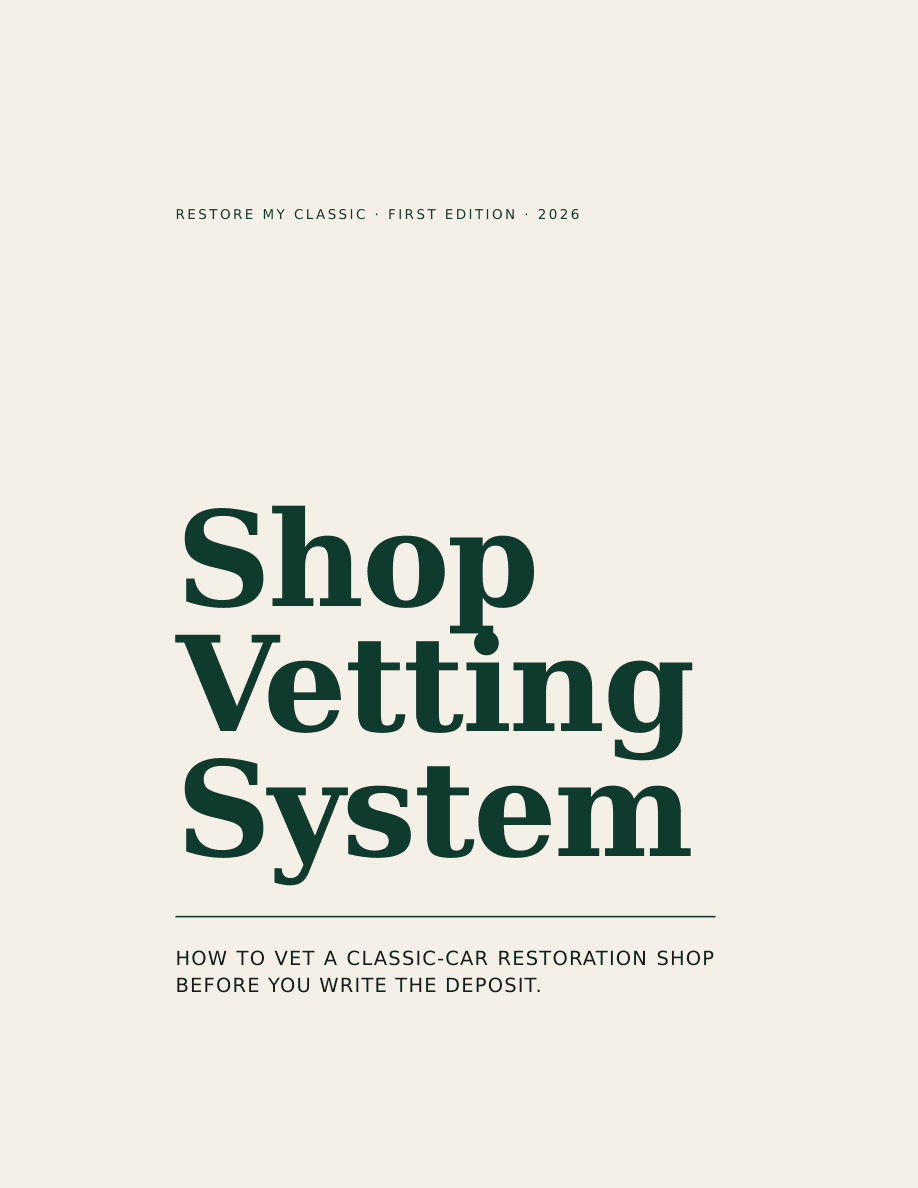
The 47 Questions · the flagship of the System
The 47 questions that turn a gut feeling into a verdict.
Both shops seem good — that's the trap, not the comfort. The 47 questions, the scoring, the contract checkpoints, and the sourced cost data turn that gut feeling into a scored verdict: commit with confidence, or walk away knowing exactly why. One weekend.
145 pages · 47 scored questions · 24-point attorney workbook · 200+ cost benchmarks · shop-scoring spreadsheet
30-day decision-or-refund guarantee. No subscription.
Founder launch · $79 $19 · first 100 founders
What you'll know after one weekend.
- Which of the 47 questions actually predict a bad outcome — and which 12 to ask in a 30-minute call.
- What a confident shop sounds like, and what a fraud-prone one sounds like, question by question.
- The 12 physical red flags you can read off a shop floor in ten minutes.
- How to verify references the shop didn't hand you — and the ones it did.
- The contract checkpoints that have to be settled before you sign, and the 3 answers that end the conversation.
- A normal deposit structure (10–25%, milestone draws) vs. the structure that creates hostages.
- How to run a free 60–90 minute background check — Secretary of State, AG complaints, PACER.
- How to score 3–5 shops and read the 20% buffer so a near-tie doesn't become a wrong “yes.”
What you actually do across one weekend.
Six steps, in order. The book walks each one — and the spreadsheet keeps the score. The public version is the free weekend sequence. The System remains the scored verdict.
Research
A 60–90 minute background check per shop: Secretary of State filings, AG complaints, PACER, BBB patterns. Free, except $0.10 a page at PACER.
Ask
The 12 highest-signal questions of the 47, in one 30-minute call. You'll hear the shop that opens its books versus the one that makes you feel rude for asking.
Visit
Walk the shop against the 12 physical red flags. The questions are what they tell you; the red flags are what they show you when they don't realize you're looking.
Verify
Call 2–3 of their recent customers and ask what you didn't ask the shop. “Would you use them again?” A “yes, but…” is a no.
Score
Rate each shop across the 7 dimensions, weighted for your project. The spreadsheet does the math.
Decide
The top shop wins only if it scores 20% clear of the next. Then your attorney redlines the contract before you sign.
In the order you actually use it.
The Quick Read
The 90-minute cheat sheet. Chapter one. Enough to walk into a shop conversation today and not get played.
Before You Write the Check
The deposit moment, what's actually at stake, and why “both shops seem good” is the trap, not the comfort.
The 47 Questions, in 9 Categories
Every question, the order you ask it in, what a good answer sounds like, and what a fraud-prone one sounds like.
Scoring and Comparison
The 7 weighted dimensions and the 20% buffer — how to turn “which feels right” into “which scored right.”
How I'd Run This on a Real $28K Project
The full worked example, start to finish: three candidate shops, the scores, the verdict, and why one walked.
The 12 Physical Red Flags
What a shop shows you when it doesn't realize you're looking — readable off the floor in ten minutes.
The Reference-Check Protocol
Who to call, what to ask the customers the shop didn't hand you, and why “yes, but…” is a no.
The Shop-Visit Walkthrough
What to do with your hour on site — the order to walk it, and the questions you only ask in person.
Contract Review
The contract checkpoints to settle before you sign, the change-order terms that govern after, and what your attorney redlines.
If It Goes Wrong Anyway
What to do if the shop folds with your car inside — the steps, the paperwork, and where leverage actually lives.
The Decision You're Making
How to commit with confidence, or walk away knowing exactly why — and how to prove it on paper either way.
Printable Scoring Sheet
The one-page sheet you take to every shop, so three visits produce three comparable scores.
State Legal Resources
Where to file, who to check, and the public records that cost nothing — by state.
Glossary
Frame-off, numbers-matching, milestone draws, the iron triangle — the vocabulary, so you sound like an owner.
About the Author
The dad's-'67 story, and why I wrote down every question I should have asked.
Sample · The 47 Questions
Bickley didn't get lucky.
Kevin Bickley did everything owners are told to do. He checked the references. He signed a contract. He wrote the deposit check — and got his car back five years later, stripped: doors gone, axle gone. He didn't get unlucky. He did it right, the way everyone tells you to do it right, and it wasn't enough — because “do your research” was never a system.
That's the whole reason this book exists. Good reviews and a long history told Bickley nothing the shop didn't want him to know. The 47 questions are built to surface what a shop won't volunteer, in the order that makes the difference impossible to miss.
“The 47 questions are what they tell you. The 12 red flags are what they show you when they don't realize you're looking.”
So you run both. You ask the questions on the call and you read the floor on the visit, and you score what you hear against what you see. A shop can rehearse the answers. It can't un-clutter the bay, un-stall the half-finished car in the corner, or explain away the deposit it already spent.
That's the difference between Bickley's outcome and yours. Not luck. A system you can run in a weekend, and prove on paper if you ever have to.
— excerpt continues in the full chapter —
Read a free preview of the System
Enter your email and I'll send a free preview of the Shop Vetting System as a PDF — a real sample of the method, yours to keep.
No spam. Unsubscribe anytime. One-payment product — no subscription.
Three sentences. Any one of them, and you walk.
Most red flags need scoring. These don't. If a shop says any of these to your face, the conversation is over.
“We only take cash.”
No paper trail, no recourse. The one term that protects the shop and exposes you.
“The deposit's non-refundable, no exceptions.”
A shop confident in its work doesn't need your money trapped before it earns it.
“We don't share the contract until you commit.”
If you can't read the terms before you sign, the terms are the problem.
What's included.
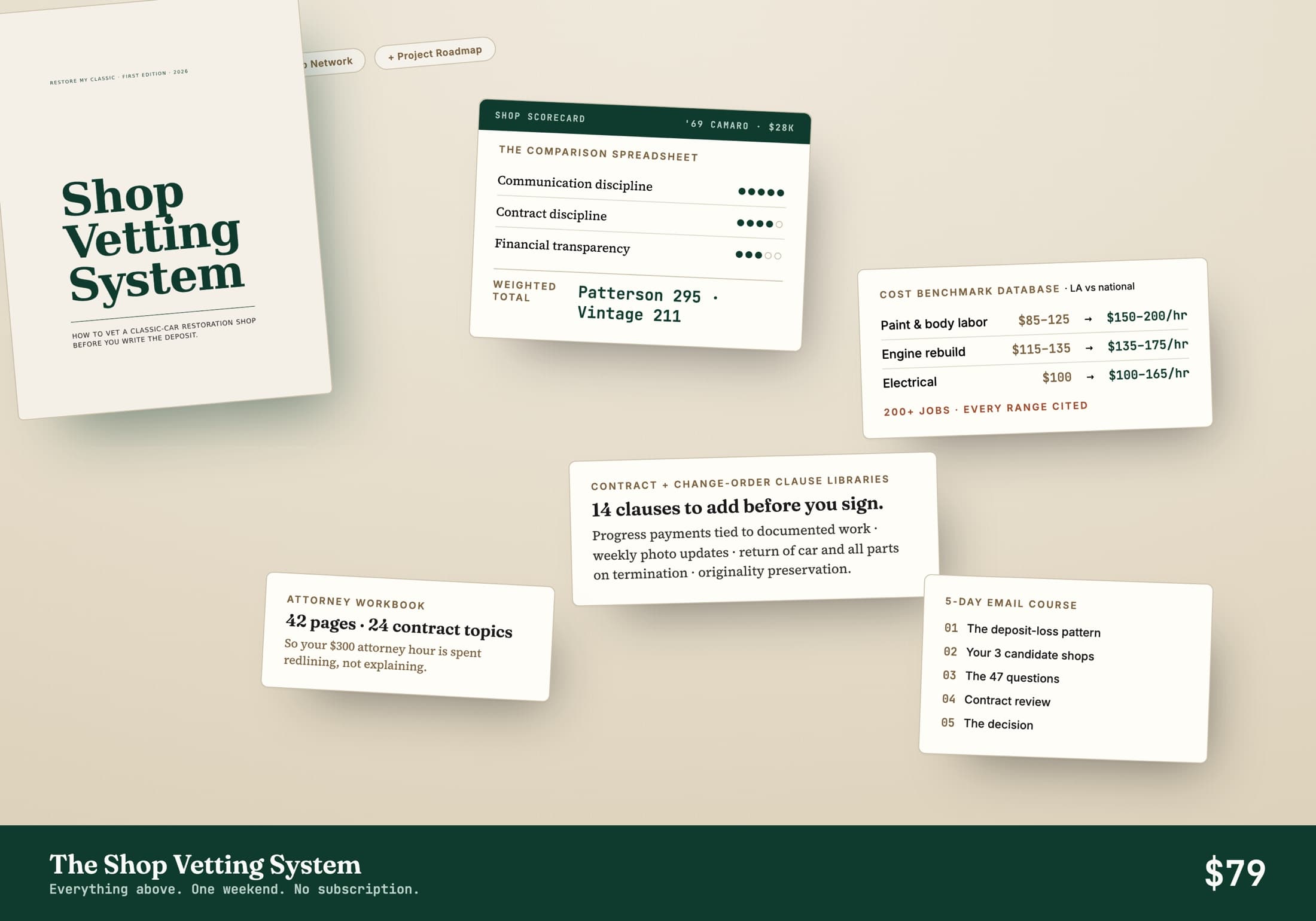
Three tools and two bonuses — the questions, the scoring, and the contract checkpoints, plus the cost data, in the order you use them across one weekend.
The 47 Questions Playbook
The 47 questions in 9 categories — what a good answer sounds like, and what a fraud-prone one sounds like. Plus the 12 physical red flags, the reference-check and background-check protocols, and what to do if a shop folds with your car inside.
The Comparison Spreadsheet
Score 3–5 shops on 7 weighted dimensions. It computes the winner. Turns “which feels right” into “which scored right.”
The Attorney Workbook
24 contract checkpoints — what to add before you sign and the change-order terms that govern after, written for you and structured for your attorney. Your $300 hour is spent redlining, not explaining. (Not legal advice.)
Cost Benchmark Database
Sourced cost ranges for 200+ jobs by era, job type, and region. Every range cites a public source. No fabricated numbers.
The Project Roadmap
A 20-question assessment that outputs a one-page Project Brief: goals, scope, a realistic budget band, and the shop type to look for.
Know what the work should cost before the quote arrives.
The quote that makes your stomach drop — is it fair, or is it the first red flag? The Cost Benchmark Database gives you sourced ranges for 200+ jobs, so you walk in with a number instead of a feeling. Here's how Los Angeles labor compares to the national base.
Sample · 1 of 13 tabs. Every range cites a public source and shows its date. Plan toward the upper third in LA: 20–30% above national.
One price. One weekend. The whole System.
Founders' launch price · first 100 buyers
One-time. No subscription. Everything above — the playbook, the spreadsheet, the attorney workbook, the course, and the three bonuses. The price returns to $79 when the founder launch ends.
Get the System · $19Read a sample chapter firstWhat the alternatives cost for less coverage:
A 2-hour appraiser consult — for one opinion.
A single pre-purchase inspection.
The whole System, a fraction of one percent of your deposit.
Founders' Edition · $19 launch price
$19 is the founder launch price for the first 100 buyers — $79 after. Buy now and you also lock in:
- Every future edition and database release, free — for the life of the product
- The counsel-reviewed contract clause library, free, the day it ships
- Your name in the acknowledgments, if you want it
- Founder updates direct from me during the launch
Run the questions on one shop. If you don't have a clear, defensible decision in 30 days, email me once — full refund, same day.
Reasonable questions.
Isn't this just questions I could Google?+
You could. You'd get 200 conflicting answers across 50 threads from people whose car, shop, and timeline aren't yours. This is one system: the exact questions, what good answers sound like, the scoring, and the contract checkpoints to hand your attorney — in the order you actually use them.
Isn't this just the free advice, repackaged?+
The free guides are the safe version — “trust your instincts,” “get recommendations.” Safe advice doesn't stop a $24,000 deposit from disappearing. This is the depth they leave out: named cases with public court records, the 24 contract checkpoints to hand your own attorney, and a scoring system that produces a verdict, not a vibe. Built by the owner who lived it.
My situation is different.+
It's built for exactly your situation: you've found a shop you like and you're about to commit before you've confirmed it. That's the moment the whole system is for.
Is this only for Mustangs?+
The vetting works for any classic — the questions don't change with the badge on the hood. The cost data is deepest on 1964½–1970 Mustang today, with other marques in development.
Is this a subscription?+
No. One payment — $19 during the founder launch (it returns to $79 after). Founders' Edition also adds every future edition and database release, free, for the life of the product.
What if it doesn't help?+
Run the 47 questions on one shop. If you don't have a clear, defensible decision within 30 days, email me and you're refunded that day.

A note from the author
This is my dad's car. A 1967 Mustang coupe, family-owned since new — he's an immigrant, it was his first new car, and my brother and I both learned to drive on it. Not valuable. Just impossible to part with.
In 2016 I dropped it at a paint shop in Southern California on a handshake and a one-page work order with no timeline. Four weeks later my contact was gone and the new guy could only tell me I was “twelfth in line.” It came back two years later. The paint was fine. I got lucky.
I built the Shop Vetting System so the next owner doesn't have to be lucky. It isn't a shop, a parts vendor, or a marketplace. It's the diligence I wish I'd run before I wrote that first check — written down, then organized into the product I couldn't find when I needed it.